

Here's a table of all the machines, and their performance in the SPEC 95 benchmarks.
SPECint 95 measures integer performance and SPECfp 95 measures floating-point performance - the numbers are the performance multiple compared to some reference machine. I'm also giving the "SPEC score per GHz", showing how much work a given processor can do per clock cycle. This allows us to compare processor architectures, even if the processors have different clock speeds.
I was unable to find results for the two Arm machines, but I suspect they would be very bad.
| Processor | Year | SPECint 95 | SPECint 95 per GHz | SPECfp 95 | SPECfp 95 per GHz |
|---|---|---|---|---|---|
| HP PA-8500 @ 400 MHz | 1998 | 31.8 | 79.5 | 52.4 | 131 |
| Intel Pentium II @ 450 MHz | 1998 | 17.6 | 39.1 | 13.1 | 29.1 |
| UltraSPARC-II @ 450 MHz | 1997 | 19.7 | 43.7 | 27.9 | 62.0 |
| Alpha 21164A @ 500 MHz | 1996 | 15.0 | 30.0 | 20.4 | 40.8 |
| HP PA-7300LC @ 132 MHz | 1996 | 6.84 | 51.8 | 7.17 | 54.3 |
| Intel Pentium PRO @ 150 MHz | 1996 | 6.08 | 40.5 | 5.42 | 36.1 |
| MIPS R8000 @ 75 MHz | 1994 | 2.8 | 37.3 | 8.9 | 118 |
| Intel Pentium @ 100 MHz | 1994 | 3.33 | 33.3 | 2.60 | 26.0 |
Here's the SPECint and SPECfp numbers as a graph.
But just to show you how much things have changed, let's add estimates for the 2016 Arm Cortex-A72, as used in the Raspberry Pi 4 and Raspberry Pi 400 (which we are using as our UNIX server). Actual SPEC95 numbers are seemingly impossible to find for such a new CPU, but because SPEC2006 gives a 296 MHz UltraSPARC-II a score of 1.0, and we have the SPEC95 numbers for a 450 MHz UltraSPARC-II, we can sort of make a guess where the Cortex-A72 will end up.

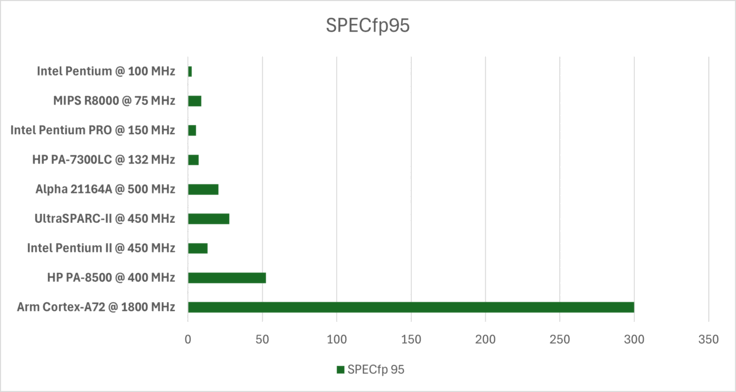
Oh. It turns out can get a LOT of RISC UNIX (relatively speaking) for $35.
This page is part of the UNIX network we set up at RetroFest 2025. You can read about:
Or you can go back to the index.
(c) Copyright Jonathan 'theJPster' Pallant, and contributors